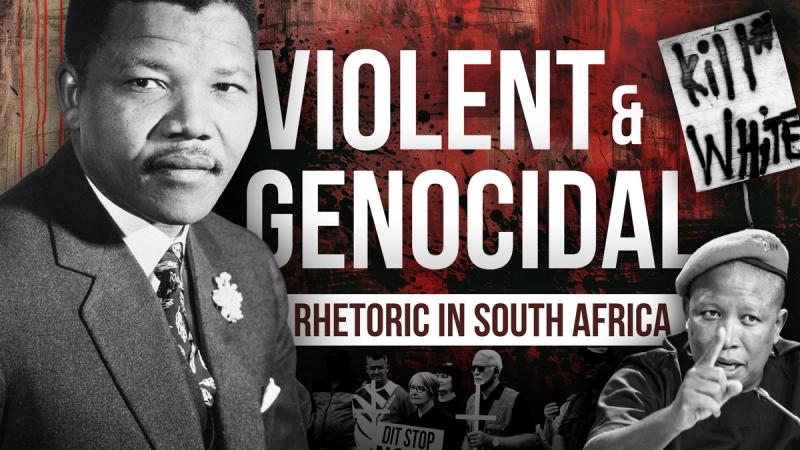
South Africa's post-1994 dispensation has been marked by a troubling normalisation of violent and genocidal rhetoric directed at ethnic minorities, particularly Afrikaners. This rhetoric, often framed as a response to historical injustices, undermines democratic principles and fosters division. While rooted in the anti-apartheid struggle, its persistence today risks inciting real-world harm against vulnerable groups. This part examines the historical context of such rhetoric, contemporary threats from major political actors, and evidence linking such rhetoric to real-world violence.
‘Kill the Boer’ in context
While the ‘Kill the Boer’ chant gained international notoriety after US President Donald Trump highlighted its use by South African politicians in 2018, it has long been condemned by targeted minority communities.
The chant was a staple of the African National Congress's (ANC) military wing, Umkhonto we Sizwe (MK) during the years of National Party rule, and popularised by the President of the ANC Youth Wing, Peter Mokaba. Comparable chants include Dubula iBhunu (Zulu for ‘Shoot the Boer’) and Hamba Kahle Mkhonto, which includes lyrics pledging to ‘kill the Boers’.
Defenders of these chants claim that it metaphorically represents liberation from white minority rule, not literal violence. However, it ought to be borne in mind that such chants weren’t just metaphors during the ANC’s armed struggle. Several ANC policy documents include references to white farmers in particular as the enemy. It was also decided at the ANC’s National Consultative Conference in Kabwe in 1985, that farms (especially border farms) had to be targeted with military operations in particular, and that the distinction between hard and soft targets in such operations should fall away.
Former commander of MK explained it as follows:
‘The fact that farms were designated as veritable targets in our struggle evolved during our campaign in the ‘80s. I also became involved with that, because following on our conference at Kabwe, one of the things we had observed was the increasing activity of farmers, South African farmers being part of the Security Force network. They were part of what was called Commandos. So we began to regard them as a legitimate target as well, because they were in our line, they were on our way… Technically people could say those farmers were just farmers, and these farmers were defending themselves, but we began to identify why we said that we should regard them as targets. Also, they might be soft targets, because, I mean, they are farmers, and they have wives and children staying with them on those farms, and they might be with their families when they tread on those landmines that we wanted to plant on their farms. But, we thought, since they are assisting and abating the system and trying to help the apartheid regime to survive, that they became legitimate targets as well.’
These years were marked by a series of brutal bombings, mass shootings, and infrastructural sabotage that resulted in numerous civilian deaths. Among the most infamous were:
- The Church Street Bomb in Pretoria (20 May 1983), which killed 19 people (including civilians) and injured 217 during rush hour.
- The Amanzimtoti Bomb (23 December 1985), planted by ANC Youth League member Andrew Zondo, which killed five civilians (including women and children) and injured dozens.
- The Messina landmine incident (1985), which claimed the lives of several members of the Van Eck and De Nysschen families.
- The Magoo’s Bar Bomb in Durban (14 June 1986), which killed three civilians and injured 69.
Post-1994, these perpetrators received notable recognition. Robert McBride, who led the MK cell responsible for the Magoo’s Bar bombing, became a Member of Parliament after the democratic transition and was appointed director of the State Security Agency's foreign branch in July 2020. Similarly, Amanzimtoti's main road, formerly Kingsway, was renamed Andrew Zondo Road to honour the operative behind the 1985 bombing.
However, it should be noted that violence specifically targeting the white minority remained relatively isolated. Over 90% of the approximately 21,000 deaths that occurred as a result of political violence during apartheid's final two decades (roughly the late 1970s to early 1990s) resulted from black-on-black conflicts, particularly between the ANC and rival groups such as Inkatha, the Azanian People’s Organisation (AZAPO), and the Black Consciousness Movement (BCM).
Contemporary threats of violence by the ANC and government officials
As South Africa's ruling party since 1994, the ANC has seen several of its prominent figures engage in rhetoric that normalises violence against ethnic minorities, particularly Afrikaners. These include both party and government representatives. This rhetoric often frames white land ownership as illegitimate by definition (regardless of the method in which land was acquired) and portrays minorities oppressors that ought to be punished as a collective.
A recurring theme in ANC discourse is the portrayal of white land ownership as "stolen," justifying aggressive redistribution measures. In 2012, when he was President of the ANC Youth League (ANCYL), the current Minister of International Relations, Ronald Lamola threatened during a press conference:
“I am just giving a warning to white South Africans: They must voluntarily bring back the land, and voluntarily bring back the mineral resources … there will be a moment when these service-delivery protestors will invade the land of Mr Van Tonder and Mr Van der Merwe and we can no longer be able to guarantee the continued safety of Mr Van der Merwe.”
This statement implies that failure to comply with demands of the ruling elite could lead to uncontrolled violence against Afrikaner farmers. Later that year in Durban, he called for “an act as forceful as war” to achieve economic freedom through “unapologetic redistribution”. The ANCYL defended his warning, describing it as precautionary and accusing critics of protecting white privilege. Though causation is difficult to prove, data from monitoring reports show a 60% increase in farm murders in the month following Lamola's June statement.
President Cyril Ramaphosa has reinforced this narrative. In a 2018 speech, he depicted white land ownership as the source of dispossession and dispossession as the “original sin” committed by “colonial invaders.”
The ANC has also consistently defended chants like “Kill the Boer” and “Shoot the Boer”, often portraying such chants as struggle heritage rather than calls to violence. In January 2012, former President Jacob Zuma sang a version of “Shoot the Boer” at the ANC's centenary celebrations, with lyrics including “We are going to shoot them with the machine gun … Shoot the Boer.” Farm attacks rose 11% and murders 36% in the following month.
In 2010, when Julius Malema was President of the ANC Youth League, he chanted “Shoot the Boer” multiple times at public gatherings, including at the University of Johannesburg and the University of Free State. He defended the chant as part of his culture. Nonetheless, it led to a 51% increase in farm murders and 88% in attacks the following month.
In April 2010, ANC spokesperson Jackson Mthembu was arrested and jailed for drunk driving. While in jail, he sang “Shoot the Boer” over the phone to a journalist, saying that the chant belongs to the ANC, not Malema.
The current Minister of Mineral and Petroleum Resources, Gwede Mantashe (then ANC Secretary General), defended the chant, saying that any judgment that describes such chants as hate speech would be “impractical and unimplementable”.
In March 2017, ANC MP Duduzile Manana shouted “Bury them alive!” (some sources say that he shouted “burn them alive!”) during a parliamentary debate on farm murders. The ANC refused disciplinary action.
Former President Thabo Mbeki also stated in 2025 that chants such as “Kill the Boer” and “Shoot the Boer” do not constitute hate speech, because the ANC does not take it literally.
In the same year, President Ramaphosa refused to condemn the Kill the Boer chant and stated that his government had no intention of taking action against those who use it.
The public incitement of farm murders is, however, not limited to members of the public and politicians. In some cases, members of the South African Police Service also publicly encourage or romanticise farm murders.
Mveleli Molwane Gwabeni, a police officer in the Eastern Cape, posted on Facebook that ‘[W]e must continue to kill more of their farmers at least to make up for what they did to us’. Chris Gumotso, who worked at the Gauteng Youth Crime Prevention Desk of the SAPS, stated that ‘All white man… deserve to die…in future…fuck u…Mr white man…’. He also posted pictures of firearms and ammunition lying on a desk in a police station and added: ‘I predict th civil war.. in mzansi [English: South Africa] …by 2019… take out ur guns… fighters coz Asijiki [English: We won’t turn back]’. Separate criminal charges were filed against Gwabeni and Gumotso, but no progress about either of these cases is known to the public. Another police officer, Constable Elvis Thabiso Sithole, was charged for posting the following on Facebook: ‘I normally suffocate a bit with a refuse bag this kind of racists, before booking them in the holdings cells, b coz it doesn’t leave any marks. They just become red and after doing the paperwork I lock them up and take the docket home so that no one can release them until they meet with the Honourable Magistrate in court the next court date’. (The comment was made in response to a video clip of a white person making a racist statement.) When he was told that his comments would be reported to his station commander, he responded by saying ‘Great news indeed…’
This pattern of rhetoric from ANC leaders and affiliates demonstrates a normalisation of threats against minorities, often without repercussions, fostering an environment where violence may be perceived as justifiable.
In South Africa, popular political members of the ruling political elite, continue to existential framing to justify racially violent speech with impunity. Equally evident is the profound lack of appropriate response by the country’s mainstream human rights champions, political entities and even the courts, regarding the blatant genocidal rhetoric aimed at ethnic minority groups.
Lex Libertas is a think tank and advocacy group working towards a viable political dispensation in South Africa, based on the principles of freedom, decentralisation, and self-governance.
To support Lex Libertas, click here.