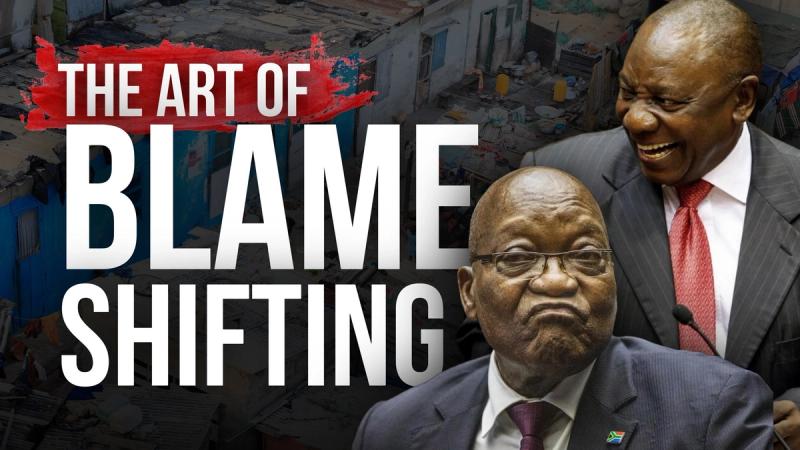
In contemporary South Africa, systemic corruption and destructive economic policies have exacerbated poverty and unemployment. However, blame is often shifted onto ethnic minorities, particularly whites and Afrikaners, to deflect responsibility from governance failures. This scapegoating perpetuates divisions and undermines accountability.
Corruption at the highest levels has drained public resources. The National Anti-Corruption Advisory Council (NACAC) report of August 2025 highlights that losses from state capture and corruption could be up to R1.5 trillion over the past decade. This severely hampers the delivery of basic services and prospects for economic growth. These policies, while proclaimed to aim at redress, function as race-based mechanisms that exclude minorities from economic opportunities, fostering resentment and inefficiency.
Despite an abundance of evidence of a destructive policy framework and government mismanagement, the South African government and the ruling African National Congress (ANC) routinely blames ethnic minorities to evade scrutiny.
The Weaponisation of White Monopoly Capital
The term "White Monopoly Capital" (WMC) was infamously weaponised during a 2016–2017 public relations campaign. This effort aimed to deflect public attention from allegations of state capture and corruption involving the Gupta family and then-President Jacob Zuma.
The Gupta family—three Indian-born brothers (Ajay, Atul, and Rajesh "Tony" Gupta)—built a vast business empire in South Africa spanning mining, media, and technology after immigrating in the 1990s. They became closely associated with Zuma, whose son Duduzane held positions in Gupta-owned companies. Critics accused the Guptas of undue influence over government decisions, appointments, and contracts—a phenomenon later termed "state capture," where private interests effectively control state resources for personal gain.
To counter growing scrutiny from journalists and investigators, the Guptas hired Bell Pottinger, a prominent British public relations firm known for managing high-profile reputations. Bell Pottinger promoted narratives of "economic apartheid" and WMC, portraying critics of the Guptas and Zuma—particularly wealthy white businessmen and investigative journalists—as agents preserving white economic dominance. This rhetoric shifted blame from corruption to racial grievances, framing opposition as racially motivated rather than evidence-based, thereby vilifying perceived white economic elites as scapegoats.
A key example involved veteran South African journalist Peter Bruce, then editor-at-large at Tiso Blackstar (publisher of Business Day and other major outlets). In June 2017, while reporting on the Guptas and state capture, Bruce faced intimidation from activists of Black First Land First (BLF), a radical political movement founded in 2015 by Andile Mngxitama. The BLF, which advocated for the confiscation of white-owned property and supported Zuma amid corruption allegations, sent around 20 protesters to Bruce's Johannesburg home. They defaced his property with slogans like "land or death" and accused him of being a "WMC propagandist."
The 2017 GuptaLeaks—a collaborative investigative project by journalists exposing Gupta-linked corruption—further intensified scrutiny, prompting a counter-campaign via an anonymous website called WMC Leaks. This site surveilled and smeared journalists as "agents of WMC" or "lapdogs of the Rupert family." The Rupert family, led by billionaire Johann Rupert (chairman of luxury goods firm Richemont and investment company Remgro), is one of South Africa's wealthiest and most prominent white business dynasties, often symbolised as the epitome of white economic power in WMC narratives.
Black journalists investigating the allegations were particularly vilified as "askaris"—a term from the apartheid era (derived from Arabic/Swahili for "soldier") but in South African political discourse referring to black collaborators or traitors who betrayed the liberation struggle by working with the apartheid security forces. This label heightened personal risks for all journalists involved.
By August 2017, the UK's Public Relations and Communications Association (PRCA)—a leading professional body for the PR industry—investigated complaints and found Bell Pottinger guilty of breaching its ethical codes by inflaming racial divisions. The firm was expelled (a rare and severe sanction, lasting five years), leading to the resignation of CEO James Henderson. The scandal contributed to Bell Pottinger's collapse into administration shortly afterward.
Despite the Zondo Commission (the official inquiry into state capture) later implicating over 1,438 individuals and entities, with investigation costs exceeding R1 billion, high-profile prosecutions remained limited by mid-2025, with only a fraction of cases finalised. The WMC campaign exemplifies how scapegoating—vilifying perceived white economic elites and their alleged allies—served to deflect accountability from corruption, perpetuating racial divisions while shielding those implicated.
Scapegoating Minorities to Evade Accountability
Strategic vilification and scapegoating by the political elite in South Africa extends far beyond the scope of investigative entities.
Members of the political elite in South Africa have become adept at selectively emphasizing historical events to generalize blame. Perhaps the greatest example is the history of land dispossession. It is indeed the case that certain land belonging to black people was dispossessed by the white minority government in an attempt to establish the homeland system of the 20th century. These events are presented by contemporary politicians to suggest that all white people engaged in dispossession, that virtually all land that belonged to black people was dispossessed and that all black people were victims of dispossession. The fact that land belonging to white people was also dispossessed and that white people acquired lands through other means as well, including acquisition of unoccupied land and purchase of land, is conveniently overlooked.
In the creation of this narrative, some statistics are fabricated, including the oft-repeated claim by politicians that “whites own 80% of the land” in South Africa. Other statistics are misrepresented or distorted. Perhaps the most noteworthy example is the false claim that “whites own 70% of the land”, which is said to be based on a finding by a land audit report by the Department of Rural Development and Land Reform. The truth is, however, that the report found that white people own 72% of the 39% of land that is owned by individuals (thus 28%).
By extrapolating this narrow data point to all land ownership (either deliberately or through negligence), political actors misrepresent land statistics to portray ethnic minorities as illegitimate occupiers. In doing so, dispossession of white-owned land as a political solution to the country’s problems becomes a political talking point deflecting accountability from state corruption and policy failure.
In November 2017, President Cyril Ramaphosa attributed black impoverishment to land theft, saying: "Our land was stolen from our forebears, leading to the destruction of the asset base of the African people and resulting in the impoverishment of the black nation.” Nkosazana Dlamini-Zuma echoed this, stating that whites "have looted and even stolen the land from black people" while criticizing ANC transformation plans for not being aggressive enough.
When speaking to disgruntled ANC voters in Limpopo, Ramaphosa invoked past fears to regain support from disillusioned voters. In answer to an unemployed single mother in Seshego vowing never to vote ANC again, Ramaphosa claimed that "If you don't vote, the Boers will come back to control us."
While speaking at an ANC fundraising dinner in Cape Town (2015), former President Jacob Zuma effectively blamed all the “trouble” in South Africa on the arrival of white people, saying:
“You must remember that a man called Jan van Riebeeck arrived here on 6 April 1652, and that was the start of the trouble in this country… What followed were numerous struggles and wars and deaths and the seizure of land and the deprivation of the indigenous peoples’ political and economic power.”
Warnings From Minority Rights Champions.
Several minority rights organisations and champions have expressed deep concern at President Zuma’s distortion of Afrikaner-related history. At a joint-sitting debate at Parliament, Dr Mulder addressed Zuma’s racialised comments:
“The Honourable President says a man called Jan van Riebeeck arrived here, and that was the start of problems in the country. I can prove the president is wrong. But what did he say in plain language? He said, when white people arrived here, the trouble started. What is the understanding of ordinary ANC supporters? They understand that if one gets rid of the white man, all problems are solved. Get rid of the cockroaches and all problems go away.”
In an open letter Dave Steward, former Chief of Staff to President F.W. De Klerk and Executive Director of the F.W. de Klerk Foundation at the time, expressed his concern towards the ANC’s persistent anti-Van Riebeeck campaign, stating:
“The anti-Jan van Riebeeck campaign is yet another example of the disturbing and increasingly overt anti-white posture of the President and the ANC. Indeed, the ANC’s core programme, its ‘National Democratic Revolution’, is the continuation and completion of its ‘liberation’ struggle against white South Africans whom it views as ‘antagonists”.
In the same letter, Steward records the words of the “Shoot the Boer” chant, which had been sung at the ANC’s January 8th 2012 celebrations in Bloemfontein, by President Zuma. The recording in Steward’s letter read:
“We are going to shoot them; they are going to run; we are going to shoot them, with the machine gun; they are going to run. You are a white man – we are going to hit them and you are going to run! Shoot the Boer! We are going to hit them – they are going to run! The cabinet will shoot them with the machine gun! The cabinet will shoot them with the machine gun! Shoot the Boer!”
In the letter Steward noted: “Can one imagine the leader of any respectable country in the world expressing such deplorable views about a national minority?”
But the marginalised ethnic community’s fears fell on deaf ears. Unfazed by the existential threat experienced by many within the Afrikaner community as a direct result of the ANC government’s antagonistic stance towards ethnic minorities, Zuma doubled down on his divisive statements. In what was described as a “12 minute lecture on how the arrival of the first white settlers affected black people...” Zuma responded to criticism, stating that “When I said when Jan van Riebeeck landed in the Cape our problems began, it’s a historical fact”.
There are many more cases of vilification and scapegoating of minorities by members of South Africa’s political elite.
In February 2013, Lulu Xingwana, Minister for Women, Children and People with Disabilities, stated in an Australian TV interview: “Young Afrikaner men are brought up in the Calvinist religion believing that they own a woman, they own a child, they own everything and therefore they can take that life because they own it.” She apologised after significant backlash, but faced no consequences.
In February 2017, during a drought in the Western Cape, Esethu Hasane, spokesperson for ANC Minister Fikile Mbalula, tweeted in response that “Only Western Cape still has dry dams. Please God, we have black people there, choose another way of punishing white people.” He was not dismissed. His boss, Fikile Mbalula, now ANC Secretary-General, depicted white people in August 2025 as bloodthirsty murderers targeting each other and black people.
By scapegoating ethnic minorities and distorting historical facts, the ANC has leveraged vilification to maintain power and evade accountability, at the expense of the people they have sworn to serve.
Lex Libertas is a think tank and advocacy group working towards a viable political dispensation in South Africa, based on the principles of freedom, decentralisation, and self-governance.
To support Lex Libertas, click here.