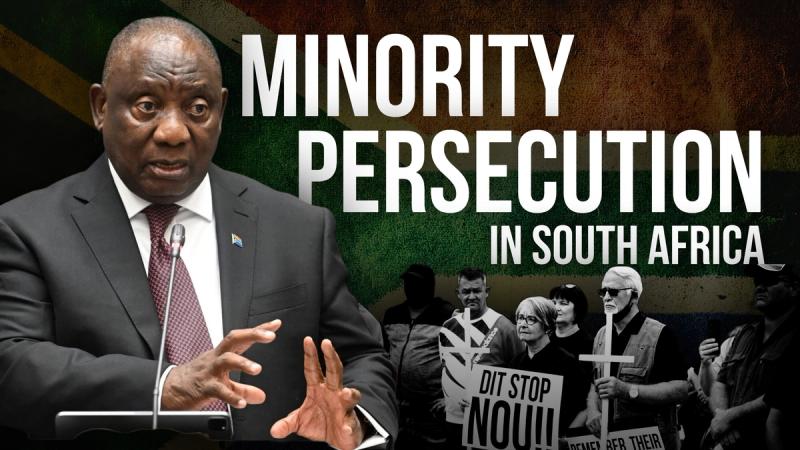
In a recent address ahead of the G20 summit in Johannesburg, South African President Cyril Ramaphosa asserted that no nation should bully another due to its economic or military power, emphasizing equality among nations and decrying international pressures on South Africa. This statement, reiterated in early 2026 amid U.S. boycotts and global scrutiny, positions South Africa as a victim of external "bullies" while aligning with authoritarian regimes abroad. Yet, this rhetoric starkly contrasts with domestic realities, where the African National Congress (ANC) government under Ramaphosa is employing similar coercive tactics against ethnic minorities within its borders.
Since its 1994 shift to democracy, South Africa has been internationally portrayed as a democratic success story. In 2004, Kofi Annan, former Secretary General of the United Nations, remarked that “A decade after South Africa's transformation into a non-racial, multi-party democracy, people around the world remember the transition from apartheid as little short of a miracle.” Today, however, more than 31 years later, the reality shows profound internal contradictions as systemic abuses, rampant corruption and gross human rights violations have brought South Africa to the brink of societal and financial collapse.
The South African “miracle” so globally celebrated by Annan and others, has devolved today into what might be described as a tyranny of the majority. Three decades after the fall of the white minority government, South Africa has more race laws than it had at the height of the apartheid system, with over 140 race laws that racially discriminate against South Africa’s minority groups. The late Dr. Mario Oriani-Ambrosini, former chief legal and constitutional adviser for the Inkatha Freedom Party (IFP) and constitutional negotiator during the CODESA negotiations, reflected on his private discussions with Cyril Ramaphosa, chief negotiator for the ANC at the time, and now President of South Africa, on the ANC’s alleged strategy for transferring wealth, land and property from minority groups to the black majority. He recorded the now infamous quote, better known as the “frog analogy”, in his memoirs released in 2017, titled The Prince and I: A South African Institutional Odyssey.
The memoir alleges that, during the CODESA talks in the ’90s, Ramaphosa shared the ANC’s strategy towards minority groups with Dr Oriani-Ambrosini. In his memoirs he recorded the following:
“In his brutal honesty, Ramaphosa told me of the ANC’s 25-year strategy to deal with the whites: it would be like boiling a frog alive, which is done by raising the temperature very slowly. Being cold-blooded, the frog does not notice the slow temperature increase, but if the temperature is raised suddenly, the frog will jump out of the water. He meant that the black majority would pass laws transferring wealth, land, and economic power from white to black slowly and incrementally, until the whites lost all they had gained in South Africa, but without taking too much from them at any given time to cause them to rebel or fight.”
Despite multiple attempts made by civil rights NGOs and private commentators alike urging Ramaphosa to clarify this deeply concerning quote, neither he nor any ANC or government official have ever issued a denial or clarification.
While Western nations have only recently intensified scrutiny of these issues, the South African government persists in denying farm murders and land invasions, even as it defends the chanting of "Kill the Boer" and expands discriminatory race laws. This hypocrisy underscores the urgency of a thorough examination: If Ramaphosa decries international bullying, how can his administration justify domestic tactics that bully minorities? This report is necessary to expose these contradictions, arguing that the ANC engages in systematic persecution of ethnic minorities, undermining South Africa's democratic credentials and global standing. By highlighting evidence across ten categories, it demonstrates a pattern of rhetoric, policy, and action that amounts to state-enabled abuse.
The report is structured around these ten categories:
- Violent and Genocidal Rhetoric: Influential politicians, including allies of the ruling party, have promoted chants and speeches glorifying the extermination of minorities.
- Vilification, Scapegoating, and Blame-Shifting: Elites, including Ramaphosa and allies, routinely blame minorities for national woes, fostering division.
- A Vast Network of Exclusionary Race Laws: Over 145 laws discriminate against minorities in employment and opportunities, despite claims of empowerment.
- The Confiscation of Legally Owned Private Property Belonging to Minorities: Policies enable seizure without compensation, with racial targeting explicit in leadership statements.
- Unfettered Land Grabs and Land Invasions: Illegal occupations exploit legal loopholes, often resulting in permanent loss for owners.
- An Ongoing Scourge of Farm Murders: Exceptionally violent attacks on farms, linked to political incitement, with victims blamed by officials.
- Death by Regulation: Overregulation hinders self-reliance in security and utilities, exacerbating government failures.
- Denial of Rights: Interpretations of democracy grant fewer rights to minorities, with courts upholding discriminatory rulings.
- Public Denial by the President: Ramaphosa has repeatedly denied these issues in international forums, including meetings with U.S. leaders.
- International Positioning and Diplomatic Contradictions: While claiming victimhood from democratic nations, South Africa aligns with repressive regimes, praising policies that suppress minorities.
These categories collectively reveal a coordinated strategy of marginalization, contradicting the ANC's post-apartheid promises. The implications extend beyond South Africa, threatening regional stability, human rights norms, and investor confidence. The following sections delve into each category with detailed evidence, urging policymakers, civil society, and the international community to hold the government accountable and advocate for genuine equality.
Lex Libertas is a think tank and advocacy group working towards a viable political dispensation in South Africa, based on the principles of freedom, decentralisation, and self-governance.
To support Lex Libertas, click here.
To watch the video, click here.