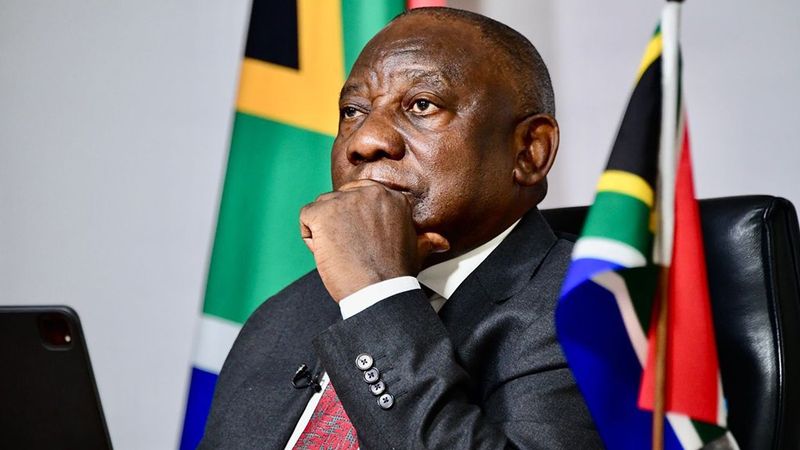
President Cyril Ramaphosa’s government may continue to dismiss growing international concern about the crises in South Africa, but reality is unavoidable. The fact of the matter is that the country is in serious trouble — and no amount of denial or blame-shifting (or the strange attempts at combining the two) will fix it. I say “crises” in the plural, because South Africa does not face only one challenge. It suffers from a fusion of multiple crises at the same time.
These include:
- The consequences of a destructive economic policy
- State collapse
- Extreme levels of corruption
- Violent crime that is out of control
- The persecution of minority communities
The President would like the world to believe that growing international pressure is merely the result of “misinformation” by unnamed groups and individuals. Yet anyone who has spent even a day in South Africa can see that this claim is disingenuous. Anyone who follows the news knows that the country’s trajectory cannot be dismissed as mere conspiracy.
What is often lost in the debate, however, is that these crises are interconnected. This is not simply a convergence of unrelated problems that happen to appear at the same moment. Together, they point to a political dispensation that is faltering at its foundations.
For Ramaphosa to respond by dismissing criticisms as “baseless allegations” is not a strategy; it is avoidance. Worse still, it damages the country’s credibility at a time when international investors, foreign governments, and global institutions are already sceptical of South Africa’s stability. The more the government insists that the problems do not exist, the more it confirms to the world that it is unwilling — or unable — to deal with them.
This does not mean that South Africa’s future is doomed. On the contrary, certain key policy shifts would go a long way toward restoring confidence. A firm commitment to the rule of law, the abandonment of racialised economic legislation such as BEE, and the protection of property rights would each send a powerful signal that South Africa is serious about reform. These alone would help calm markets, reassure investors, and stabilise diplomatic relations.
Yet these adjustments, important as they are, will not be enough.
South Africa’s central problem is not simply policy failure; it is the centralised nature of the political order itself. For decades, too much power has been concentrated in a national government that is increasingly incapable of managing it. This is not only true of the ANC government — it was also true of the National Party government before them, and of South Africa as a Union under the British Empire before that. The point is not to return to the past, but to move beyond the very structural feature that underpinned failure under the British, the National Party, and now the ANC.
The consequences of a highly centralised state presiding over a large and diverse territory are predictable: state failure at every level, communities left to fend for themselves, and a political elite insulated from accountability — slow to act when action is needed, yet swift to entrench its own power.
What the country truly needs is meaningful decentralisation and genuine self-governance for its diverse communities. This is not a radical idea. Around the world, decentralised governance has proven to be a stabilising force, especially in societies marked by diversity and historical tension. It allows communities to govern their own affairs, strengthens responsiveness from the state, and reduces the burden on a failing national centre.
South Africa’s crises will not be wished away. Nor will they be solved by denial, spin, or government press statements. The world is watching — and increasingly, it is losing patience. If South Africa hopes to restore its international standing and secure long-term stability, it must embrace the principle of self-governance. That begins with decentralisation, strengthened community autonomy, and a return to the foundational principles of a just and viable constitutional system.
Dr Ernst Roets is the Executive Director of Lex Libertas
Support the work of Lex Libertas here