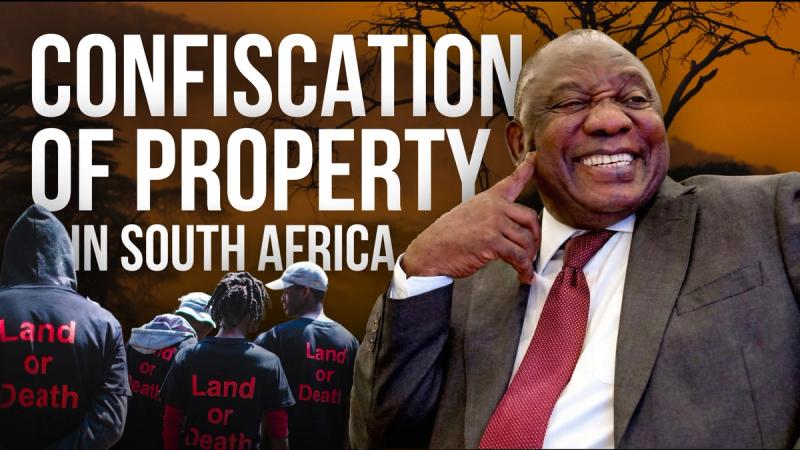
In February 2018, South Africa's Parliament adopted a motion to review and amend Section 25 of the South African Constitution to explicitly empower the state to expropriate private property without compensation. The policy of expropriation without compensation is usually abbreviated as EWC, although it should be stated from the get-go that “confiscation” is a more appropriate term than “expropriation”. This decision sparked significant outrage domestically and internationally, with critics warning of threats to property rights, economic instability, reduced investment, and parallels to failed reforms elsewhere. Despite the backlash, the ruling elite in South Africa doubled down, pushing forward with the policy as essential for redress and equity, dismissing concerns as resistance to transformation. Significant concerns were raised about the process, including procedural irregularities in public consultations, such as inadequate consideration of submissions, flawed committee processes, and potential violations of constitutional requirements for rationality and public participation. Critics also argued that amending the Constitution was unnecessary, as Section 25 already permits nil compensation in certain "just and equitable" circumstances through progressive interpretation, without explicit changes. Ultimately, the constitutional amendment failed in December 2021, because it lacked the required two-thirds majority. This failure was primarily due to the Economic Freedom Fighters (EFF) rejecting it as insufficiently transformative for not mandating state custodianship of all land and preventing blanket, unconditional confiscation of privately held land. As a result, party leader Julius Malema argued that the amendment “would set back black people’s struggle for land repossession.” In response, the political elite focused on advancing the Expropriation Act, introduced in 2020, passed by Parliament in 2022, and signed into law as Act 13 of 2024 by President Ramaphosa on 23 January 2025, repealing the 1975 Act and incorporating nil compensation provisions.
Restitution vs Redistribution
The fact that the terms ‘restitution’ and redistribution’ are used interchangeably in South Africa is indicative of a deep-rooted problem relating to the persecution of minorities. At face value, restitution implies the correction of an injustice, while redistribution implies changing patterns of ownership through state intervention. In contemporary political discourse, the fact that a comprehensive restitution process has been followed (discussed below) is generally disregarded. That process has not resulted in patterns of land ownership that represent national demographics (for reasons which would be discussed below). As a result, the focus has shifted to redistribution as the only acceptable form of restitution.
Furthermore, the shift from restitution to redistribution (and the consensus among the political elite that redistribution is the only acceptable method of restitution), necessarily implies that all property that is white-owned is regarded as ‘stolen land’. The focus is no longer on addressing particular cases where black people were dispossessed, but on ensuring that the white minority owns significantly less property. As a result of this shift, all property owned by white people is viewed as illegitimate, regardless of the method in which that property was acquired.
Land claims
Land claims in South Africa primarily refer to the initial restitution process, which allowed individuals, families, or communities dispossessed of land rights after 19 June 1913 as a result of the Natives Land Act of 1913, to claim restoration of the land, equivalent land, or financial compensation. This mechanism, established under the Restitution of Land Rights Act, formed a core component of ANC-led land reform aimed at addressing historical injustices. Yet, despite significant budgets allocated towards this process, progress has been remarkably slow, inefficient, and prone to corruption, exacerbating minority vulnerabilities through prolonged uncertainty over property rights.
The land claims process opened in 1995 following the Act's promulgation, with an initial deadline for lodging claims set at 31 December 1998. Claims could be submitted by direct victims of dispossession or their descendants, requiring proof of historical ownership or rights, the discriminatory nature of the dispossession, and that no just and equitable compensation was received at the time. The process involved several steps: lodging the claim with the Commission on Restitution of Land Rights (CRLR); research and validation by the Commission to verify eligibility; gazetting of the claim for public notice; negotiation between claimants, current landowners, and the state; and final settlement through agreement (under Section 42D of the Act) or adjudication by the Land Claims Court if disputes arise.
During the initial claims period (1995-1998), approximately 79,700 claims were filed, representing millions of beneficiaries through community-based submissions. The process reopened from 1 July 2014 to 30 June 2019, adding over 163,000 claims, for a total of around 242,700 lodged overall. By December 2024, 83,348 claims (about 34% of the total) have been settled, awarding 3,897,495 hectares to beneficiaries, though a significant backlog persists with over 5,700 pre-1998 claims and thousands from the reopened period unresolved.
The fact that the vast majority of land claims (up to 80%) were filed in urban areas significantly discredits the often-repeated claim by members of the ruling elite that aggressive land reform with regard to farm land is necessary as a result of a great ‘hunger for (agricultural) land’. Even more significant is the fact that around 90% of land claimants have made it clear that they would rather receive financial compensation than actual land restoration. During his 2017 State of the Nation Address, former President Jacob Zuma addressed this matter as follows:
“Most importantly, we appeal to land claimants to accept land instead of financial compensation. Over 90% of claims are currently settled through financial compensation, which does not help the process at all. It perpetuates dispossession. It also undermines economic empowerment.”
This is a remarkable statement, because it signals that the political elite is committed to a project that is not supported by the populace at large, and that, insofar as the people do not support the project (large scale expropriation of land from the white minority), they are reprimanded.
Legal and policy breakdown
The Expropriation Act defines "expropriation" as the compulsory acquisition of property for a public purpose or in the public interest by an expropriating authority, or an organ of state upon request to an expropriating authority. "Property" is broadly interpreted, by merely referencing section 25 of the South African Constitution, extending beyond land to include movable assets, intellectual property, and unregistered rights, creating potential for wide-ranging state seizures that critics argue threaten minority-owned businesses and assets. Terms like "just and equitable" and "public interest" are not defined and instead left deliberately vague, allowing the expropriating authority discretionary power to decide compensation, including "nil compensation" in specified circumstances such as abandoned land, state investments exceeding value, or health and safety risks—a non-exhaustive list that enables subjective application by the ruling elite
Critics of the Act have been assured that expropriation of property cannot be arbitrary, as a list of criteria is provided for the determination of compensation as “nil”. However, critics have pointed out that the list of criteria is irrelevant, as it is preceded by the words:
“The amount of compensation must be just and equitable reflecting an equitable balance between the public interest, the interests of those affected, including an owner, holder of a right a morgagee (sic), having regard to all relevant circumstances, including…”
The inclusion of the word “including” implies that the list of criteria is open-ended and that other factors (not included in the act) can also be considered to determine that expropriation should happen without compensation. As a result, the wording of the act opens the door to broad interpretation and legally protected abuse beyond the stated categories. The IRR explains:
That (the use of the word “including”) means that market value is just one of the factors the expropriating authority will consider when determining how much compensation to offer you. It could easily abuse the list of “relevant circumstances” (plus any others it can think of) to offer you less than market value. It is unlikely you will receive compensation for any direct financial losses (the old Expropriation Act of 1975 included compensation for direct loss, but this has been omitted from the current Act).
Similarly, the Free Market Foundation (FMF) has expressed concerns over this ambiguity, arguing that the non-exhaustive nature of the nil compensation provisions renders the Act unconstitutional and tantamount to confiscation, undermining property rights and constitutionalism.
While the Act claims to prohibit arbitrary expropriation and mandates judicial oversight for disputes, these safeguards are undermined by the ambiguity in key phrases, which could facilitate targeted dispossession of minorities under the pretext of redress, blurring lines between restitution (historical claims) and redistribution (broader race-based transfers). This framework forfeits democratic legitimacy by vesting control in a notably corrupt state, perpetuating majority tyranny over property rights.
Reckless Remarks by Political Elites
Members of the political elite in South Africa have been exceptionally reckless in public discussions regarding the confiscation of property, promising that the confiscation of property would create a utopia, explicitly stating that it would be a race-based process, threatening violence against white people who don’t comply and venerating some of the world’s most oppressive regimes and destructive policies. These remarks consistently frame white ownership of property as illegitimate by definition and aggressive government intervention as the only acceptable solution.
President Cyril Ramaphosa publicly stated that confiscating private property would transform South Africa into the "Garden of Eden" and the "ultimate paradise." Former Deputy President, David Mabuza threatened that there would be a “violent takeover” if white farmers did not voluntarily hand over their property. Zweli Mkhize, then ANC treasurer-general, asserted in 2018 that the ANC would ensure that no black-owned property would be confiscated.
Additionally, South African political elites, including ANC and EFF leaders, routinely venerate destructive land reform models from the Soviet Union, Venezuela, Cuba, Zimbabwe, and China, presenting them as inspirations for South Africa's transformation despite their histories of economic collapse, famines, and human rights abuses. For instance, President Ramaphosa in 2025 praised Zimbabwe's land reform as "essential" and "ambitious" during a visit to Harare, despite its role in economic ruin. ANC leaders have historical ideological ties to Cuba and the Soviet Union, praising Cuba's collectivization as a model of equity and anti-imperialism, with the ANC condemning US aggression against Venezuela in 2026 and viewing its land seizures under Chávez and Maduro as triumphs against Western dominance. EFF leader Julius Malema has echoed this by pushing for radical expropriation inspired by Zimbabwe's fast-track reforms, rejecting moderation and criticizing the Expropriation Act as insufficiently transformative, while admiring Mugabe's approach despite its disastrous outcomes. China's state-controlled land policies are also admired by ANC figures, with leaders praising China's model of state ownership and rural intervention as a blueprint for equitable land use in South Africa.
Broader implications
The Expropriation Act, with its ambiguities, reckless rhetoric, and veneration of failed international models, exemplifies how South Africa's ruling elite perpetuates the persecution of minorities through policies that undermine property rights, economic stability, and democratic principles. By enabling arbitrary takings under vague "public interest" criteria and ignoring lessons from the collapse of countries like Zimbabwe and Venezuela, the South African political elite’s quest for confiscation of property that belongs to minority communities could potentially lead to mass dispossession, investor flight, and heightened emigration among minority groups, particularly white farmers and business owners, who face targeted exclusion as remnants of "colonial" ownership. This not only exacerbates economic decline—evidenced by warnings of reduced prosperity and social instability—but also erodes the rule of law, fostering a "tyranny of the majority" where minorities are systematically marginalized in the name of historical redress. Under these circumstances (and when considering aspects of minority persecution discussed in other sections of this report), it is not unreasonable to express serious concern about potential ethnic cleansing in South Africa.
Broader implications include the potential for international sanctions, as seen in US concerns over property rights violations, which could further isolate South Africa and deepen poverty for all citizens.